



When shopping for a lab-grown diamond, you'll likely encounter grading reports from several different laboratories. Alongside GIA, one of the most common is the International Gemological Institute (IGI), a grading lab that evaluates both natural and lab-grown diamonds.
Although both GIA and IGI issue similar diamond grading reports, they should not be viewed as equivalent. GIA is widely regarded as the industry's benchmark for consistent, conservative grading, while IGI has developed a reputation among many jewelers and gemologists for applying more lenient grading standards. As a result, two diamonds carrying the same color and clarity grades from different laboratories may not represent the same level of quality.
VeraLume™ was developed to provide an even more comprehensive evaluation—one that not only upholds rigorous grading standards but also looks beyond the traditional 4Cs to assess characteristics that conventional grading reports often overlook. The result is a clearer, more complete picture of a lab-grown diamond's true visual quality and performance.
So how do VeraLume and IGI compare? Let's take a closer look.
The International Gemological Institute (IGI) is one of the world's largest independent gemological laboratories. It grades both natural and lab-grown diamonds using the traditional 4Cs: cut, color, clarity, and carat weight.
For many years, GIA was considered the gold standard for grading both natural and lab diamonds. However, after GIA transitioned away from issuing traditional color and clarity grades for lab diamonds, IGI quickly became the most commonly encountered grading report in the lab diamond market.
For many buyers, it's become the default grading standard—not necessarily because it's considered the most rigorous, but because it's the most widely available.
While IGI reports provide valuable information about a diamond's basic characteristics, widespread use shouldn't be mistaken for equivalent grading standards. Within the jewelry industry, IGI has long been viewed by many gemologists and diamond professionals as more lenient than GIA, particularly when assigning color and clarity grades. As a result, two diamonds with identical grades from different laboratories may not represent the same level of quality.
This distinction is one of the reasons VeraLume was developed. Rather than relying solely on traditional grading methods, VeraLume applies rigorous grading standards while evaluating additional characteristics that conventional reports often overlook, providing buyers with a more complete understanding of a lab diamond's true quality.
Within the jewelry industry, IGI has long had a reputation for assigning more generous color and clarity grades than GIA. While grading is always performed by trained professionals and no two diamonds are exactly alike, many jewelers and gemologists believe that a diamond receiving a particular grade from IGI may receive a lower grade if evaluated by GIA.
This perception of grading leniency has led many consumers to ask an important question: if two diamonds carry the same grades but were evaluated by different laboratories, are they truly equal?
The answer isn't always yes.
Grading standards can vary from one laboratory to another, making it difficult to compare diamonds based solely on the information listed on a traditional grading report. That's one of the reasons many buyers look beyond the report itself and consider additional factors when evaluating a lab-grown diamond.
Rather than simply assigning grades based on the traditional 4Cs, VeraLume was created to evaluate the characteristics that have the greatest impact on how a lab-grown diamond actually appears.
A VeraLume report includes assessments that conventional grading reports typically don't provide, including:
Unlike a traditional grading report that primarily summarizes a diamond's characteristics, every VeraLume digital report includes a 360° video of the diamond itself. Buyers can inspect the diamond from every angle while reviewing its grading results, creating a more transparent shopping experience and allowing them to see many of the qualities the report describes.
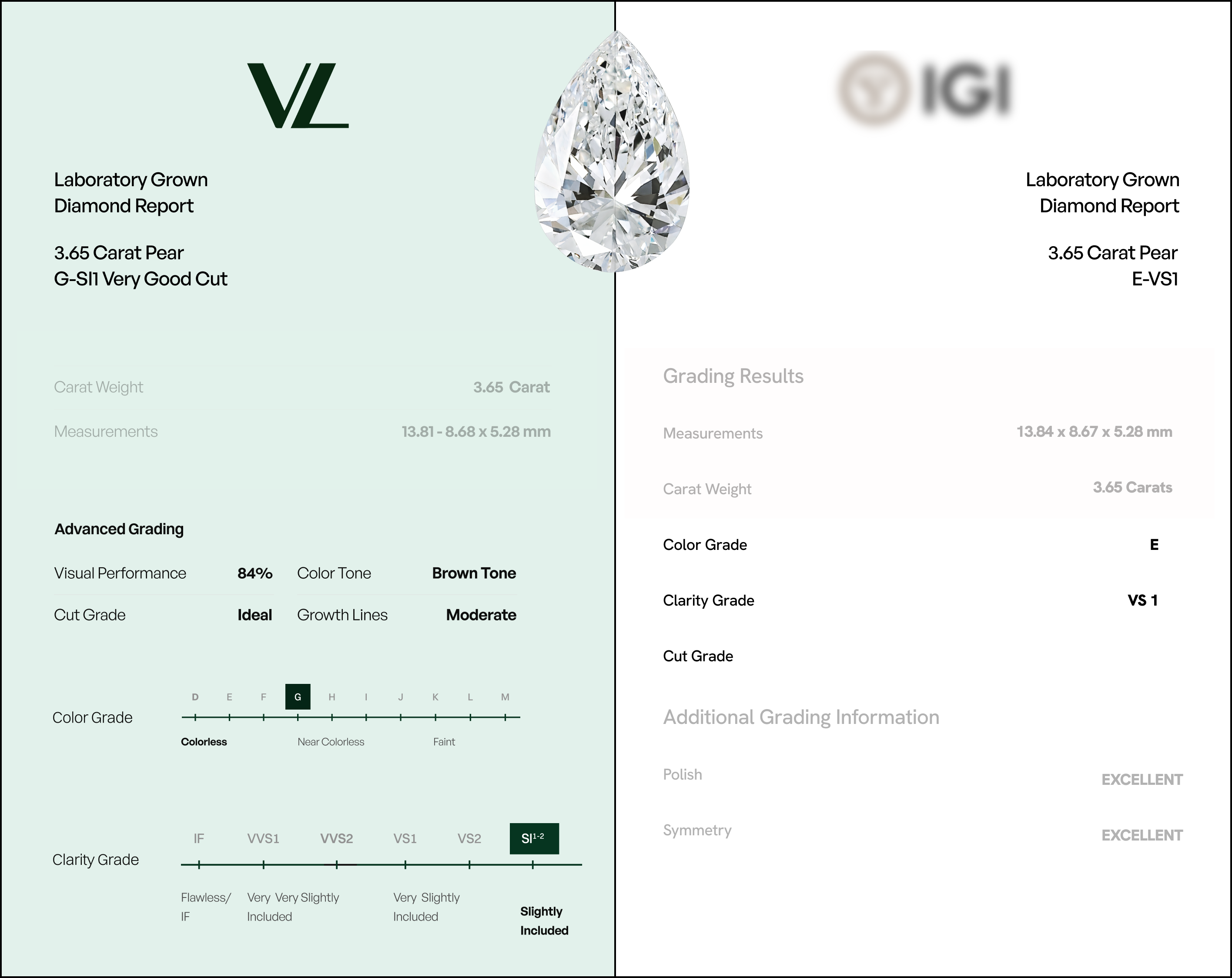
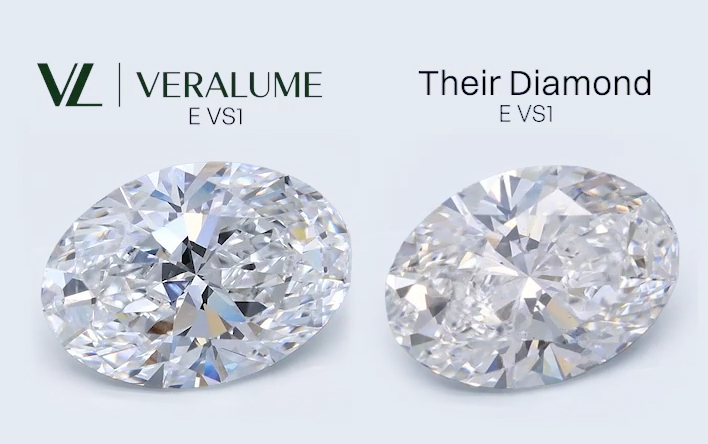
Two lab-grown diamonds can receive identical color and clarity grades while looking noticeably different in person.
For example, two diamonds may both be graded F color and VS1 clarity. On paper, they appear nearly identical. In reality, one may exhibit subtle gray undertones, visible growth patterns, or less impressive light performance than the other.
Traditional grading reports generally don't evaluate these characteristics, making it difficult for buyers to understand why one diamond appears brighter, whiter, or more lively than another.
VeraLume™ was developed to bridge that gap by evaluating the visual qualities that buyers notice most.
When purchasing a lab diamond, confidence comes from understanding exactly what you're buying.
While IGI remains a widely recognized grading laboratory, VeraLume provides an additional layer of transparency by evaluating characteristics that traditional reports often leave unaddressed. Rather than relying exclusively on standard grading categories, VeraLume helps buyers understand how a diamond is likely to look in everyday lighting.
This added insight makes it easier to compare diamonds beyond what's written on a grading report.
IGI provides a traditional grading report based on the 4Cs, making it a familiar benchmark throughout the jewelry industry.
VeraLume builds upon that foundation by evaluating additional characteristics unique to lab diamonds, offering a more comprehensive understanding of each stone's visual appeal and overall quality.
For buyers who want more than a standard grading report, VeraLume provides greater transparency into the qualities that truly distinguish one lab-grown diamond from another.
Whether you're comparing two diamonds with identical grades or simply looking for greater confidence in your purchase, VeraLume delivers a deeper level of insight designed specifically for today's lab-grown diamonds.


